G1 Wheelchair Push Policy
This page is the working summary for the wheelchair-push policy experiments. Keep current decisions here and move detailed chronological notes to the archive.
The project-level contract for what counts as success lives in the wheelchair goal spec.
The current auto-loop entrypoint for codex-autoresearch is documented in the goal spec's autoresearch section.
Current Status
The video is the preserved model_13300.pt hard-attachment visual reference.
It demonstrates the best known walking-with-chair behavior from this branch, not
a completed sim-to-real policy. Training is currently paused while the contact
model and moving-chair curriculum are reconsidered.
| Item | Value |
|---|---|
| Active training task | Paused after Phase 1D5 visual/contact diagnosis |
| Last rendered playback | Phase 1D5 no-collision pose-tethered release, model_3400.pt, attached to T3 chat on May 25 |
| Main config | source/unitree_rl_lab/unitree_rl_lab/tasks/locomotion/robots/g1/29dof/wheelchair_push_env_cfg.py |
| Observation helpers | source/unitree_rl_lab/unitree_rl_lab/tasks/locomotion/mdp/observations.py |
| Attachment helper | source/unitree_rl_lab/unitree_rl_lab/tasks/locomotion/mdp/events.py |
| Phase 1 source checkpoint | fixed-chair low-load stand model_1448.pt from 2026-05-23_18-28-52_fixed_lowload_from_fixedstand_949_may23 |
| Bridge source checkpoint | model_19247.pt from the good 1 m/s PhysX-rail hard-attach run |
| Preserved 2 m/s visual reference | Unitree-G1-29dof-Wheelchair-Minimal-PhysX-Rail-Fast-Lean-Velocity-Progress-Push-Attached-Hard, logs/rsl_rl/unitree_g1_29dof_wheelchair_minimal_physx_rail_fast_lean_hard_attach_push_attached/2026-05-18_19-47-36_hard_attach_loose_guard_2048_from_13249/model_13300.pt |
| Current run | None; last diagnostic was stopped after confirming chair-intersection/contact exploit |
| Failed branch kept for comparison | logs/rsl_rl/unitree_g1_29dof_wheelchair_minimal_physx_rail_1mps_yaw_torque_hard_attach_push_attached/2026-05-18_20-34-46_hard_1mps_yawtorque_from_fastlean_13300 |
| Playback delivery | T3 chat attachment; latest-video site is retired for this workflow |
| Summary last updated | May 25, 2026, 02:25 Toronto |
| Training tmux | None |
| Training env count | 2048 |
| Latest-video page | https://workstation.tailee9084.ts.net:8002/ |
| Focused TensorBoard | http://workstation.tailee9084.ts.net:6007/ |
The previous soft-attachment run was stopped at model_15900.pt and used as the baseline for the SoftObs branch. That branch is not the visually good reference. The visually useful 2 m/s hard-attachment fast-lean lineage is preserved as the visual reference and warm-start source. The earlier 1 m/s yaw-torque hard branch did not learn useful forward push behavior and is kept only as a failed comparison branch.
Current status: the fixed-chair standing curriculum advanced through Phase 1D4. The latest stable checkpoint is model_3349.pt, trained with the wheelchair root fixed, hard hand-handle attachment, no forward push objective, and individual per-axis handle-force penalties. A May 24 playback probe loaded this policy into the Phase 1E free-chair task, where the chair is ground-locked but free in X/Y/yaw. The checkpoint loads, but it does not hold the free chair still: with zero command the chair drifts/backward and yaws. Treat model_3349.pt as a good fixed-chair standing/load-reduction policy, not as a free-chair hold policy. The May 25 pose-tethered bridge is paused: a no-collision release video looked catastrophic because the robot visually interpenetrated the chair, and a collidable rerun confirmed large invalid chair contacts immediately.
Current plan correction: do not treat the hand attachment itself as the failed mechanism. The older hard-attach branch worked, and the fixed-chair branch also produced stable standing. The next release attempt should train under moving-chair dynamics directly, likely with a controlled damping/release curriculum, instead of assuming fixed-chair standing transfers cleanly to the free chair.
August 24 CC0 Articulated Chair Candidate
A separate articulated chair was added to unitree_rl_lab from Poly Haven's
CC0 Wheelchair 01 model. It is a candidate replacement for the older Free3D
chair; the existing training-task configuration and checkpoints have not been
switched to it.
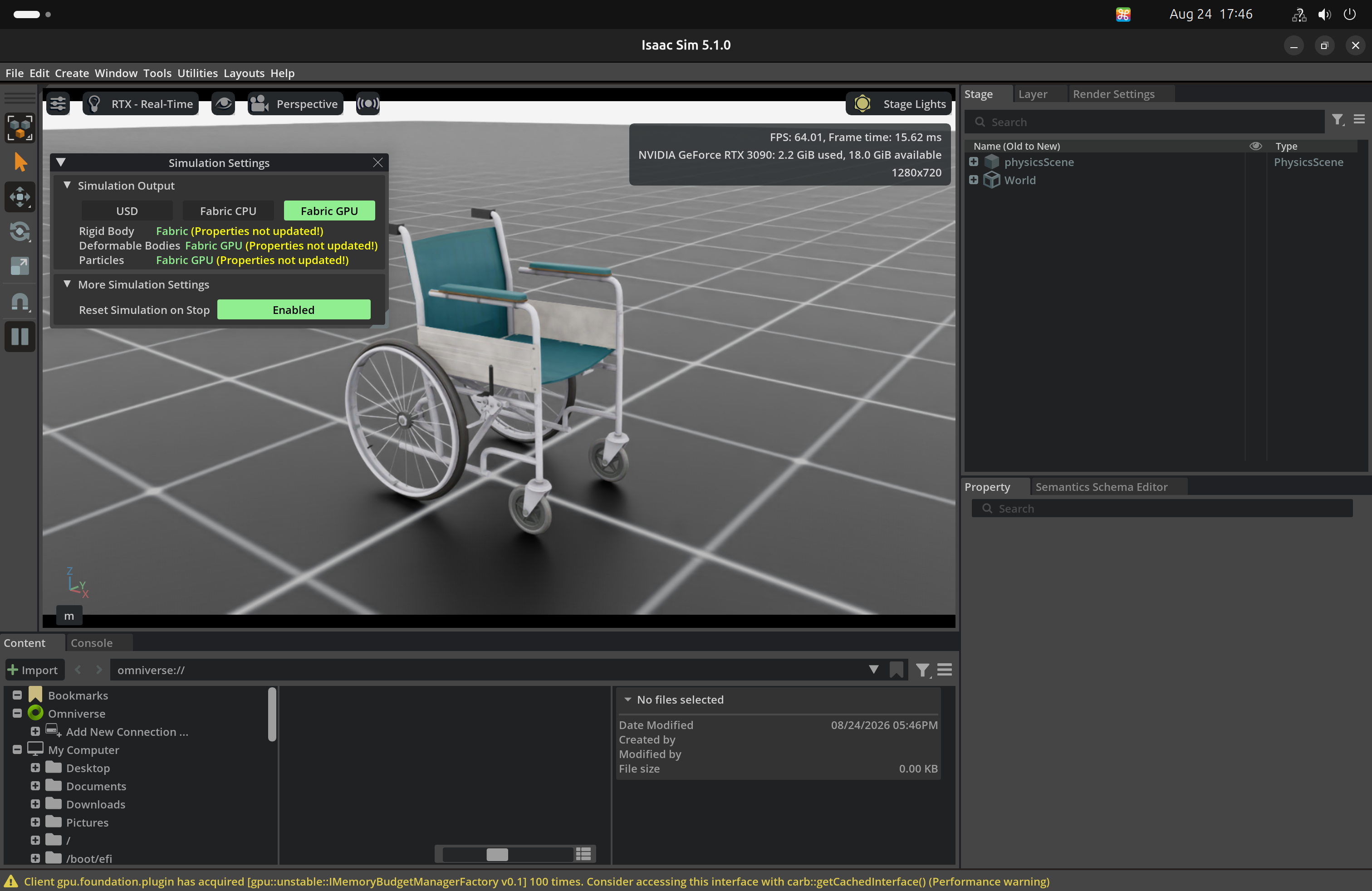
| Item | Value |
|---|---|
| Source | https://polyhaven.com/a/wheelchair_01, CC0, by Garreth Dean |
| Asset config | POLY_HAVEN_WHEELCHAIR_CFG |
| URDF | assets/objects/wheelchair/polyhaven_wheelchair_01/urdf/polyhaven_wheelchair_01.urdf |
| Importer | scripts/assets/import_polyhaven_wheelchair.py |
| Diagnostic | scripts/diagnostics/polyhaven_wheelchair_check.py |
| Articulation | Free base, two rear-wheel joints, two caster-yaw joints, and two front-wheel joints |
| Contact contract | Preserves base_link, left/right wheel bodies, and left_handle_frame / right_handle_frame |
The detailed source mesh is split into moving visual groups, while collisions are stable URDF primitives. The caster yaw defaults are rotated by 180 degrees so the wheel axles trail the swivel axes when the chair moves forward.
Chair-only validation used a constant world-X force with no robot in the scene.
A 12 N push over 360 steps at 120 Hz moved the chair 0.2981 m forward,
with 0.0016 m lateral drift and 0.0059 rad yaw. The interactive 8 N,
480-step cycle repeated at 0.2624 m forward, 0.0014 m lateral drift, and
0.0053 rad yaw. Rear and front wheel joint positions changed in both tests.
conda activate isaaclab
python scripts/diagnostics/polyhaven_wheelchair_check.py --headless

# Repeating desktop preview
python scripts/diagnostics/polyhaven_wheelchair_check.py \
  --interactive --steps 480 --force 8
Resume rule to keep straight: use full RSL-RL continuation only when continuing the same task/checkpoint lineage. For this fixed-chair standing continuation, the command intentionally uses --resume --checkpoint <model_350.pt> without --load_model_only, without --reset_critic, and without a new --policy_std. Actor warm-start mode remains appropriate when changing task lineage: --resume --checkpoint <model.pt> --load_model_only --reset_critic --policy_std <value>.
Important correction from the May 19 git-history audit and reproduction test: treat the model_13300.pt hard-attach checkpoint as a real good visual reference, not as a randomly fragile checkpoint. The exact old command from the model_13249.pt source reproduced model_13300.pt and model_13350.pt byte-for-byte on May 19. The behavior changed in the later restart/modified branches, while the original 2 m/s hard-attach path is still reproducible.
Lessons Learned
Reward terms used for diagnosis should stay factorized until the important axes are understood. The first handle-load split separated force and torque, but each term still summed local x/y/z before TensorBoard saw it. That hid the fact that the handle torque was mostly on z, then y, with much smaller x. For contact, wrench, rail, and alignment rewards, avoid one aggregate scalar too early; log and shape per axis, and only combine terms after it is clear which physical component is driving the behavior.
Net force and opposing forces are different signals. Penalizing the sum of left and right handle forces on an axis suppresses net push/pull on the fixed chair, but equal-and-opposite handle forces cancel in that sum and can still create a twisting moment. In the fixed-chair standing phase, use net force penalties to discourage leaning into the chair and torque penalties, especially around z, to discourage twisting the handles.
No-collision visual success is not physical success. The Phase 1D5 no-collision wheelchair let the robot visually pass through the chair, so wheelchair_invalid_contact stayed at 0.0 even when the rollout looked like the body was slamming into the seat/back. A collidable rerun from the same source policy immediately produced wheelchair_invalid_contact around -200, confirming the exploit. Do not continue a release phase that uses the no-collision wheelchair unless a separate geometric clearance penalty replaces physical contact.
May 23 Fixed-Chair Stand Reset
The fixed-chair standing branch is active again. This is intentionally narrower than the failed damping-release Phase 1A: the wheelchair root is fixed, the hands remain hard-attached to the handles, forward wheelchair velocity/progress rewards are disabled, and handle-force penalties are still disabled. The goal is just a reliable attached standing primitive.
Training command:
TERM=xterm conda run --no-capture-output -n isaaclab python scripts/rsl_rl/train.py \
  --headless \
  --num_envs 2048 \
  --task Unitree-G1-29dof-Wheelchair-Scratch-Phase1-FixedStand-DirectObs \
  --max_iterations 600 \
  --resume \
  --checkpoint /home/zeul/GIT/unitree_rl_lab/logs/rsl_rl/unitree_g1_29dof_wheelchair_scratch_phase1_fixed_stand_directobs/2026-05-23_05-28-52_scratch_phase1_fixed_stand_from_zero_may23/model_350.pt \
  --run_name fixed_stand_true_resume_from_350_may23
Launch log:
logs/rsl_rl/fixed_stand_true_resume_from_350_may23.launch.log
Resume verification: the log shows Loading model checkpoint from the fixed-stand model_350.pt path and then Learning iteration 350/950. This confirms the run resumed the saved actor, critic, optimizer, and exploration state instead of silently starting from iteration zero. Early continuation metrics still show bad_orientation = 0.0, fall_termination = 0.0, and no active handle-force penalty: robot_hand_wrench = 0.0, wheelchair_handle_wrench = 0.0.
The true-resume run finished and saved model_949.pt. It was rendered with the slow_revolve_best view and published to the latest-video site:
logs/demos/unitree-wheelchair-scratch-phase1-fixed-stand-directobs_model_949_slow_revolve_best_20260523_182027/model_949_slow_revolve_best.mp4
May 23 Fixed-Chair Handle-Force Phase
The next phase is now running. It starts from the stable fixed-chair standing actor, keeps the wheelchair root fixed, keeps hard hand-handle attachment, leaves all forward wheelchair push rewards disabled, and adds a small load penalty so the robot learns to stand without leaning hard through the handles.
Task:
Unitree-G1-29dof-Wheelchair-Scratch-Phase1B-FixedLowLoadStand-DirectObs
Training command:
TERM=xterm conda run --no-capture-output -n isaaclab python scripts/rsl_rl/train.py \
  --headless \
  --num_envs 2048 \
  --task Unitree-G1-29dof-Wheelchair-Scratch-Phase1B-FixedLowLoadStand-DirectObs \
  --max_iterations 500 \
  --resume \
  --checkpoint /home/zeul/GIT/unitree_rl_lab/logs/rsl_rl/unitree_g1_29dof_wheelchair_scratch_phase1_fixed_stand_directobs/2026-05-23_16-25-33_fixed_stand_true_resume_from_350_may23/model_949.pt \
  --load_model_only \
  --reset_critic \
  --policy_std 0.005 \
  --run_name fixed_lowload_from_fixedstand_949_may23
Launch log:
logs/rsl_rl/fixed_lowload_from_fixedstand_949_may23.launch.log
This is intentionally actor warm-start mode rather than full same-lineage continuation, because the reward changed. The command loads the fixed-stand actor from model_949.pt, resets the critic, and uses low exploration noise. The log confirms Learning iteration 949/1449, so the run started from the intended checkpoint.
Load penalty weights:
| Term | Weight |
|---|---|
robot_hand_wrench |
-0.04 |
wheelchair_handle_wrench |
-0.02 |
The low-load run finished at model_1448.pt and stayed stable: mean episode length reached the 500 step cap with time_out = 1.0, bad_orientation = 0.0, and base_height = 0.0. The penalty was active but too weak to change the behavior much. The final scalar values stayed near robot_hand_wrench = -1.02 and wheelchair_handle_wrench = -0.02, so the next branch increases the load penalty.
May 23 Stronger Fixed-Chair Handle-Force Phase
The stronger branch is now running from the low-load model_1448.pt actor. It keeps the same fixed-chair, hard hand-handle, no-forward-reward scaffold, but raises the load penalty by 3x.
Task added in unitree_rl_lab commit 99a25e3:
Unitree-G1-29dof-Wheelchair-Scratch-Phase1C-FixedMediumLoadStand-DirectObs
Training command:
TERM=xterm conda run --no-capture-output -n isaaclab python scripts/rsl_rl/train.py \
  --headless \
  --num_envs 2048 \
  --task Unitree-G1-29dof-Wheelchair-Scratch-Phase1C-FixedMediumLoadStand-DirectObs \
  --max_iterations 500 \
  --resume \
  --checkpoint /home/zeul/GIT/unitree_rl_lab/logs/rsl_rl/unitree_g1_29dof_wheelchair_scratch_phase1b_fixed_lowload_stand_directobs/2026-05-23_18-28-52_fixed_lowload_from_fixedstand_949_may23/model_1448.pt \
  --load_model_only \
  --reset_critic \
  --policy_std 0.005 \
  --run_name fixed_mediumload_from_lowload_1448_may23
Load penalty weights:
| Term | Low-load phase | Medium-load phase |
|---|---|---|
robot_hand_wrench |
-0.04 |
-0.12 |
wheelchair_handle_wrench |
-0.02 |
-0.06 |
Final train status: the run finished and saved model_1947.pt. The robot stayed stable through the end: mean episode length remained at the 500 step cap with time_out = 1.0, bad_orientation = 0.0, and base_height = 0.0. The stronger scalar penalty stayed active, but the underlying load still did not clearly improve. Near the end, robot_hand_wrench stayed around -3.1 to -3.2 and wheelchair_handle_wrench around -0.07 to -0.08; divided by the 3x larger weights, that is roughly the same load scale as the low-load branch.
Rendered output:
logs/demos/unitree-wheelchair-scratch-phase1c-fixed-mediumload-stand-directobs_model_1947_slow_revolve_best_20260523_220000/model_1947_slow_revolve_best.mp4
May 24 Hand-Handle Wrench Diagnostic
After the medium-load run, playback diagnostics were added to print raw incoming-joint wrench stats for the robot hand bodies and the wheelchair handle bodies:
conda run --no-capture-output -n isaaclab python scripts/rsl_rl/play.py \
  --headless \
  --task Unitree-G1-29dof-Wheelchair-Scratch-Phase1C-FixedMediumLoadStand-DirectObs \
  --num_envs 10 \
  --checkpoint logs/rsl_rl/unitree_g1_29dof_wheelchair_scratch_phase1c_fixed_mediumload_stand_directobs/2026-05-23_20-17-55_fixed_mediumload_from_lowload_1448_may23/model_1947.pt \
  --print-hand-handle-wrench-stats \
  --hand-handle-wrench-stats-steps 300
Logs:
logs/rsl_rl/hand_handle_wrench_zero_actions_model_1947.log
logs/rsl_rl/hand_handle_wrench_policy_model_1947.log
The diagnostic compared the trained policy against a zero-action playback. The reset sample prints zero because it is taken before PhysX has stepped the hard hand-handle constraints, so it is not a useful preload measurement by itself. The rollout sample is the meaningful part.
| Playback | Robot hand force mean | Robot hand torque mean | Wheelchair handle force mean | Wheelchair handle torque mean |
|---|---|---|---|---|
| Zero actions | 14723.66 N |
223.58 Nm |
81.58 N |
63.91 Nm |
model_1947.pt policy |
13952.54 N |
207.45 Nm |
61.97 N |
50.76 Nm |
The policy reduced the raw handle-side wrench somewhat, but it barely reduced the robot-hand incoming wrench. The robot-hand signal is also two orders of magnitude larger than the handle-side force signal. That suggests robot_hand_wrench is dominated by the hard attachment/articulation reaction, not by a clean "how gently is the robot touching the handle" measurement. Simply increasing robot_hand_wrench again is therefore unlikely to teach a better behavior; the policy may be punished for a constraint reaction it cannot reduce much.
Next experiment should not just raise the scalar weight. Better options are to favor the wheelchair-handle wrench over the robot-hand wrench, split force and torque into separately logged and separately weighted terms, add a left-right imbalance penalty, and verify the hard-attachment alignment after a short settled step instead of reading the pre-solve reset state.
May 24 Split Handle-Load Phase
This branch implements the next diagnostic from the wrench data above. It removes the robot-side hand wrench penalty from the active reward and replaces the combined wheelchair handle wrench scalar with two separate handle-side rewards:
| Term | Weight |
|---|---|
robot_hand_wrench |
0.0 |
wheelchair_handle_wrench |
0.0 |
wheelchair_handle_force |
-0.06 |
wheelchair_handle_torque |
-0.06 |
Task added in unitree_rl_lab commit 86de3b6:
Unitree-G1-29dof-Wheelchair-Scratch-Phase1D-FixedSplitHandleLoadStand-DirectObs
Smoke verification used 4 envs for one iteration from the Phase 1C model_1947.pt checkpoint. The reward table showed the intended terms: robot_hand_wrench = 0.0, wheelchair_handle_wrench = 0.0, wheelchair_handle_force active, and wheelchair_handle_torque active.
Training started May 24 at 03:52 Toronto in tmux session train_split_handle_load.
Run directory:
logs/rsl_rl/unitree_g1_29dof_wheelchair_scratch_phase1d_fixed_split_handle_load_stand_directobs/2026-05-24_03-52-00_fixed_split_handle_load_from_medium_1947_may24
Launch log:
logs/rsl_rl/fixed_split_handle_load_from_medium_1947_may24.launch.log
Training command:
TERM=xterm conda run --no-capture-output -n isaaclab python scripts/rsl_rl/train.py \
  --headless \
  --num_envs 2048 \
  --task Unitree-G1-29dof-Wheelchair-Scratch-Phase1D-FixedSplitHandleLoadStand-DirectObs \
  --max_iterations 500 \
  --resume \
  --checkpoint /home/zeul/GIT/unitree_rl_lab/logs/rsl_rl/unitree_g1_29dof_wheelchair_scratch_phase1c_fixed_mediumload_stand_directobs/2026-05-23_20-17-55_fixed_mediumload_from_lowload_1448_may23/model_1947.pt \
  --load_model_only \
  --reset_critic \
  --policy_std 0.005 \
  --run_name fixed_split_handle_load_from_medium_1947_may24
The purpose is not to make the force penalty stronger yet. The first test is whether the policy can reduce the cleaner handle-side force/torque terms when the artifact-heavy robot-hand wrench term is not part of the active reward.
Initial live status: startup reached Learning iteration 1948/2447 cleanly with robot_hand_wrench = 0.0, wheelchair_handle_wrench = 0.0, wheelchair_handle_force active, wheelchair_handle_torque active, and no bad_orientation term. This confirms the run is using the intended split-load task.
The latest-video site was restarted at 03:54 Toronto so the New Video button targets the Phase 1D split handle-load project.
May 24 Axis-Split Handle-Load Phase
The previous Phase 1D task split handle force and torque into two scalars, but each scalar still summed across local x/y/z before averaging left and right handles. That made the TensorBoard signal too blended: a large yaw-like torque could hide inside one aggregate wheelchair_handle_torque value.
Phase 1D2 splits the wheelchair handle load into six separate reward terms:
| Term | Weight |
|---|---|
wheelchair_handle_force_x |
-0.06 |
wheelchair_handle_force_y |
-0.06 |
wheelchair_handle_force_z |
-0.06 |
wheelchair_handle_torque_x |
-0.06 |
wheelchair_handle_torque_y |
-0.06 |
wheelchair_handle_torque_z |
-0.06 |
The old aggregate active terms are off in this branch: robot_hand_wrench = 0.0, wheelchair_handle_wrench = 0.0, wheelchair_handle_force = 0.0, and wheelchair_handle_torque = 0.0.
Task added in unitree_rl_lab commit f1739fe:
Unitree-G1-29dof-Wheelchair-Scratch-Phase1D2-FixedAxisHandleLoadStand-DirectObs
Training started May 24 at 04:47 Toronto from the Phase 1D model_2446.pt checkpoint:
TERM=xterm conda run --no-capture-output -n isaaclab python scripts/rsl_rl/train.py \
  --headless \
  --num_envs 2048 \
  --task Unitree-G1-29dof-Wheelchair-Scratch-Phase1D2-FixedAxisHandleLoadStand-DirectObs \
  --max_iterations 500 \
  --resume \
  --checkpoint /home/zeul/GIT/unitree_rl_lab/logs/rsl_rl/unitree_g1_29dof_wheelchair_scratch_phase1d_fixed_split_handle_load_stand_directobs/2026-05-24_03-52-00_fixed_split_handle_load_from_medium_1947_may24/model_2446.pt \
  --load_model_only \
  --reset_critic \
  --policy_std 0.005 \
  --run_name fixed_axis_handle_load_from_split_2446_may24
Live startup confirmed the intended signal separation. At Learning iteration 2447/2946, the old aggregate terms were zero and the per-axis terms showed torque mostly in y and z: wheelchair_handle_torque_x = -0.0003, wheelchair_handle_torque_y = -0.0029, and wheelchair_handle_torque_z = -0.0072.
The latest-video site was restarted at 04:48 Toronto so the New Video button targets the Phase 1D2 axis-split project.
May 24 Torque + Net Force Phase
The Phase 1D2 run showed the dominant bad term was still wheelchair_handle_torque_z, while the per-handle force-axis penalties were less directly tied to the behavior we care about. Phase 1D3 therefore removes the individual force-axis magnitude penalties and keeps only handle torque axes plus net handle force axes.
This distinction matters: summing left and right force catches total load into the fixed chair, but equal-and-opposite forces cancel in the sum and are instead handled by the torque penalties. The active standing-only penalties are:
| Term | Weight |
|---|---|
wheelchair_handle_torque_x |
-0.06 |
wheelchair_handle_torque_y |
-0.06 |
wheelchair_handle_torque_z |
-0.06 |
wheelchair_handle_net_force_x |
-0.06 |
wheelchair_handle_net_force_y |
-0.06 |
wheelchair_handle_net_force_z |
-0.06 |
The aggregate and per-handle force terms are off: wheelchair_handle_force = 0.0, wheelchair_handle_force_x/y/z = 0.0, and wheelchair_handle_torque = 0.0.
Task added in unitree_rl_lab commit 550b942:
Unitree-G1-29dof-Wheelchair-Scratch-Phase1D3-FixedTorqueNetForceStand-DirectObs
The obsolete Phase 1D2 training session was stopped before launching this branch. Training started May 24 at 05:14 Toronto from the Phase 1D2 model_2700.pt checkpoint:
TERM=xterm conda run --no-capture-output -n isaaclab python scripts/rsl_rl/train.py \
  --headless \
  --num_envs 2048 \
  --task Unitree-G1-29dof-Wheelchair-Scratch-Phase1D3-FixedTorqueNetForceStand-DirectObs \
  --max_iterations 500 \
  --resume \
  --checkpoint /home/zeul/GIT/unitree_rl_lab/logs/rsl_rl/unitree_g1_29dof_wheelchair_scratch_phase1d2_fixed_axis_handle_load_stand_directobs/2026-05-24_04-47-58_fixed_axis_handle_load_from_split_2446_may24/model_2700.pt \
  --load_model_only \
  --reset_critic \
  --policy_std 0.005 \
  --run_name fixed_torque_net_force_from_axis_2700_may24
Live startup confirmed the intended reward set. At Learning iteration 2704/3200, wheelchair_handle_force_x/y/z = 0.0, wheelchair_handle_torque_x/y/z were active, and wheelchair_handle_net_force_x/y/z were active.
The latest-video site was restarted at 05:14 Toronto so the New Video button targets the Phase 1D3 torque + net force project.
May 24 Individual Handle-Force Phase
Phase 1D4 backs up to the simplest requested signal: minimize the individual force components on the two wheelchair handle bodies. This branch does not use handle torque penalties, net-force penalties, or aggregate wrench penalties. The active load terms are only:
| Term | Weight |
|---|---|
wheelchair_handle_force_x |
-0.06 |
wheelchair_handle_force_y |
-0.06 |
wheelchair_handle_force_z |
-0.06 |
The force helper squares each selected handle body's signed force component and averages across the two handles, so this penalizes both hands/handles individually. This is intentionally simple and does not cancel opposite left/right forces.
Task added in unitree_rl_lab commit e1feb95:
Unitree-G1-29dof-Wheelchair-Scratch-Phase1D4-FixedIndividualForceStand-DirectObs
The obsolete Phase 1D3 torque + net force session was stopped before launching this branch. Training started May 24 at 05:32 Toronto from the Phase 1D3 model_2850.pt checkpoint:
TERM=xterm conda run --no-capture-output -n isaaclab python scripts/rsl_rl/train.py \
  --headless \
  --num_envs 2048 \
  --task Unitree-G1-29dof-Wheelchair-Scratch-Phase1D4-FixedIndividualForceStand-DirectObs \
  --max_iterations 500 \
  --resume \
  --checkpoint /home/zeul/GIT/unitree_rl_lab/logs/rsl_rl/unitree_g1_29dof_wheelchair_scratch_phase1d3_fixed_torque_net_force_stand_directobs/2026-05-24_05-14-31_fixed_torque_net_force_from_axis_2700_may24/model_2850.pt \
  --load_model_only \
  --reset_critic \
  --policy_std 0.005 \
  --run_name fixed_individual_force_from_torque_net_2850_may24
Live startup confirmed the intended reward set: wheelchair_handle_force_x/y/z are active, while wheelchair_handle_torque_x/y/z and wheelchair_handle_net_force_x/y/z are all 0.0.
The latest-video site was restarted at 05:33 Toronto so the New Video button targets the Phase 1D4 individual-force project.
Free-Chair Playback Probe
After Phase 1D4 finished at model_3349.pt, the checkpoint was loaded directly into the free-chair standing task:
Unitree-G1-29dof-Wheelchair-Scratch-Phase1E-FreeStand-DirectObs
This was a playback probe only, not a training run. The Phase 1E setup keeps the wheelchair on the ground plane but removes artificial X/Y/yaw damping, so the chair can move freely on the floor while the command remains zero.
Playback command:
TERM=xterm conda run --no-capture-output -n isaaclab python scripts/rsl_rl/play.py \
  --headless \
  --video \
  --video_length 700 \
  --video-start-step 0 \
  --video-follow-robot \
  --video-camera-orbit-deg 360 \
  --video-camera-eye-offset -4.4 -3.0 2.0 \
  --video-camera-target-offset 0.5 0.0 0.9 \
  --num_envs 10 \
  --task Unitree-G1-29dof-Wheelchair-Scratch-Phase1E-FreeStand-DirectObs \
  --checkpoint /home/zeul/GIT/unitree_rl_lab/logs/rsl_rl/unitree_g1_29dof_wheelchair_scratch_phase1d4_fixed_individual_force_stand_directobs/2026-05-24_05-33-07_fixed_individual_force_from_torque_net_2850_may24/model_3349.pt \
  --print-wheelchair-speed-stats \
  --print-hand-handle-wrench-stats \
  --speed-stats-steps 700 \
  --hand-handle-wrench-stats-steps 700
Result: the policy loads cleanly, but the fixed-chair standing behavior does not transfer to a free chair. With zero forward command, the wheelchair moved backward on average at about -0.50 m/s, had lateral absolute speed about 0.36 m/s, and yaw absolute speed about 0.60 rad/s. Only about 9.7% of samples stayed within 0.10 m/s of zero forward velocity. Robot-side incoming-joint force was also high, with mean hand force norm about 2646 N.
Conclusion: this checkpoint is a good fixed-chair standing/load-reduction policy, but it is not yet a free-chair hold policy. The next release attempt should train under the free-chair dynamics instead of relying on a fixed-chair policy to transfer directly.
Phase 1D5 Pose-Tethered Release
The May 25 release attempt starts from the Phase 1D4 model_3349.pt actor. It keeps zero forward command and keeps the individual per-axis handle-force penalties, but switches the wheelchair from fixed-root to a dynamic root. The first two attempts showed why velocity damping alone is not enough:
| Attempt | Result |
|---|---|
Heavy release, x=0.05, y/yaw=0.02, scratch PPO runner |
Failed fast; bad_orientation climbed toward 0.8 within the first few iterations. |
Planar velocity clamp, x/y/yaw=0.0, conservative PPO runner |
Still failed; wheelchair root position drift accumulated even with velocity clamped. |
Pose-tethered no-collision resume from model_3400.pt |
Metrics looked less severe than the video, but playback showed the robot driving its body into/through the chair. Invalid-contact metrics were blind because the wheelchair asset had collisions disabled. |
Pose-tethered collidable rerun from fixed model_3349.pt |
Confirmed the visual diagnosis: wheelchair_invalid_contact immediately reached roughly -197 to -205, time_out stayed around 0.28 to 0.32, and bad_orientation was about 0.45 to 0.52. The run was stopped. |
The pose-tether event itself is useful, but this branch is paused. mdp.tether_root_planar_pose_velocity pulls the wheelchair root back toward its start X/Y/yaw without making the asset a fixed-base object, but the next attempt must also make body-chair clearance part of the task. Either train with the collidable wheelchair from the start and keep invalid-contact penalties active, or keep the no-collision asset only with an explicit geometric clearance penalty.
Active task added in unitree_rl_lab:
Unitree-G1-29dof-Wheelchair-Scratch-Phase1D5-HeavyDampedIndividualForceRelease-DirectObs
Current launch:
TERM=xterm conda run --no-capture-output -n isaaclab python scripts/rsl_rl/train.py \
  --headless \
  --num_envs 2048 \
  --task Unitree-G1-29dof-Wheelchair-Scratch-Phase1D5-HeavyDampedIndividualForceRelease-DirectObs \
  --max_iterations 1500 \
  --resume \
  --checkpoint /home/zeul/GIT/unitree_rl_lab/logs/rsl_rl/unitree_g1_29dof_wheelchair_scratch_phase1d4_fixed_individual_force_stand_directobs/2026-05-24_05-33-07_fixed_individual_force_from_torque_net_2850_may24/model_3349.pt \
  --load_model_only \
  --reset_critic \
  --policy_std 0.005 \
  --run_name pose_tethered_individual_force_release_conservative_from_fixed_force_3349_may25
This branch intentionally uses the conservative standing fine-tune PPO settings rather than the scratch PPO settings. The scratch runner's larger learning rate and clip range were too destructive for a warm-started release phase.
Earlier scalar-only read at iteration 3365: the pose tether kept wheelchair_root_position near 0, and the run was no longer in the immediate bad_orientation > 0.8 failure mode. That read was incomplete. Visual playback showed catastrophic chair interpenetration, and the collidable rerun proved the missing signal was body-chair contact, not just base orientation.
May 23 Rigid-To-Free Bridge
This branch is not the standing-only scratch Phase 1A run. It starts from the successful 1 m/s hard-attach PhysX-rail actor and removes the forward rail gradually. The first bridge keeps hard hand-handle attachment and the wheelchair ground-plane lock, leaves forward X motion free, and damps only the unstable lateral/yaw axes. It intentionally keeps forward push rewards, so it is now paused as a transfer diagnostic rather than the active standing curriculum.
Current task:
Unitree-G1-29dof-Wheelchair-Minimal-FreeYaw-GroundLock-1mps-Fast-Lean-HeavyDamping-Push-Attached-Hard
Training command:
TERM=xterm conda run --no-capture-output -n isaaclab python scripts/rsl_rl/train.py \
  --headless \
  --num_envs 2048 \
  --task Unitree-G1-29dof-Wheelchair-Minimal-FreeYaw-GroundLock-1mps-Fast-Lean-HeavyDamping-Push-Attached-Hard \
  --run_name freeyaw_heavydamp_from_19247_may23 \
  --resume \
  --checkpoint logs/rsl_rl/unitree_g1_29dof_wheelchair_minimal_physx_rail_1mps_fast_lean_hard_attach_push_attached/2026-05-19_15-22-06_hard_attach_1mps_continue_full_from_18248_may19/model_19247.pt \
  --load_model_only \
  --reset_critic \
  --policy_std 0.03 \
  --max_iterations 500
Bridge settings:
| Axis | Setting |
|---|---|
| Forward X velocity | free, x_velocity_scale = 1.0 |
| Lateral Y velocity | heavily damped, y_velocity_scale = 0.05 |
| Chair yaw velocity | heavily damped, yaw_velocity_scale = 0.05 |
| Ground plane | height, roll, and pitch constrained so the chair stays on the floor |
| Rewards added beyond the rail task | lateral velocity, forward-line drift, yaw velocity, root heading, forward-heading penalties |
Early signal at iteration 19252: unlike the scratch release, the bridge produced useful rollouts. bad_orientation was below 0.001, base_height was 0.0, unstable robot/chair resets were 0.0, and wheelchair forward progress was nonzero.
The first bridge checkpoint, model_19300.pt, was rendered at 13:27 Toronto and published to the latest-video site. Training remained live during render. Around iteration 19333, the training process was still healthy: time_out was about 0.986, bad_orientation about 0.014, base_height 0.0, unstable_robot_state 0.0, unstable_wheelchair_state 0.0, and wheelchair_forward_progress about 0.87. This is not a solved free-chair push yet, but it is a viable non-rigid bridge branch compared with the failed scratch damping-release run.
Playback also confirmed that the actor policy observation vector is getting robot joint state and chair state. For this task, policy obs shape is (585,), including joint_pos_rel, joint_vel_rel, last_action, base_ang_vel, projected_gravity, velocity_commands, wheelchair_root_state, and wheelchair_handle_state. In other words, the immediate issue is not that PPO is missing the robot joint angles; the harder part is transitioning from rail/rigid support to a chair that can drift and yaw without destabilizing the learned push.
The latest-video site was restarted at 13:24 Toronto so the New Video button targets unitree-wheelchair-freeyaw-groundlock-1mps-fast-lean-heavydamp-hard-attach-push-attached.
May 22 Free-Yaw Ground-Lock Playback
The next diagnostic asks whether the best 1 m/s hard-attach policy can still push when the chair is not held on the PhysX X/yaw rail. This is playback-only for now, not a training branch.
Task added in unitree_rl_lab commit 661b663:
Unitree-G1-29dof-Wheelchair-Minimal-FreeYaw-GroundLock-1mps-Fast-Lean-Push-Attached-Hard
The task uses the regular no-collision wheelchair URDF instead of active_manual_wheelchair_x_rail.urdf. It keeps the hard hand-handle attachment and the same policy/reward shape as the 1 m/s reference, but the only wheelchair constraint event is:
constrain_wheelchair_to_ground_plane
That event pins wheelchair height, roll, and pitch every environment step, while preserving X, Y, yaw, and yaw velocity. In other words: all four wheels are effectively kept on the floor, but the chair is free to drift sideways or rotate if the policy pushes off-center.
Playback command:
isaac-clip send unitree-wheelchair-freeyaw-groundlock-1mps-fast-lean-hard-attach-push-attached \
  --view slow_revolve_best \
  --checkpoint /home/zeul/GIT/unitree_rl_lab/logs/rsl_rl/unitree_g1_29dof_wheelchair_minimal_physx_rail_1mps_fast_lean_hard_attach_push_attached/2026-05-19_15-22-06_hard_attach_1mps_continue_full_from_18248_may19/model_19247.pt \
  --run-dir /home/zeul/GIT/unitree_rl_lab/logs/rsl_rl/unitree_g1_29dof_wheelchair_minimal_physx_rail_1mps_fast_lean_hard_attach_push_attached/2026-05-19_15-22-06_hard_attach_1mps_continue_full_from_18248_may19 \
  --provider site \
  --training-policy continue \
  --no-compress-site-video
Rendered output:
logs/demos/unitree-wheelchair-freeyaw-groundlock-1mps-fast-lean-hard-attach-push-attached_model_19247_slow_revolve_best_20260522_045657/model_19247_slow_revolve_best.mp4
The Isaac event table for this playback showed constrain_wheelchair_to_ground_plane as the only interval event; there was no constrain_wheelchair_to_forward_rail event and no PhysX X-rail asset in the task. The latest-video site was restarted with this project as the New Video target.
Status after inspecting the playback and running raw speed stats: the policy does not transfer cleanly once yaw is free. It still produces intermittent chair motion, but it does not walk straight or track the 1.0 m/s wheelchair command. Over 900 steps and 10 envs, measured wheelchair base_link forward speed averaged only 0.0183 m/s, with 0.8% of samples within 0.10 m/s of the command. Mean absolute yaw rate was 0.8466 rad/s, mean absolute lateral speed was 0.3206 m/s, and the final centerline offset averaged 0.3932 m. Treat the rail-free playback as a failed transfer diagnostic: the current actor is relying heavily on the rail/yaw constraint.
Operational note: the first render attempt failed before environment creation because the workstation had an NVIDIA driver/library mismatch after an update (580.126.09 kernel module loaded with 580.159.03 user-space libraries). The final successful render was made after rebooting into the matching 580.159.03 driver. Future whole-workstation reboots should be cleared with the team first.
Rail-Free Curriculum Task List
Rule for this curriculum: each phase stops at its gate. Do not roll straight into the next phase. At each gate, render a playback to the latest-video site, send a Telegram notification, write the status here, then wait for review before continuing.
Use isaac-clip for the review gate. The normal shape is:
isaac-clip send <phase-project> \
  --view slow_revolve_best \
  --provider site \
  --training-policy continue
For automatic checkpoint gates inside a phase:
isaac-clip watch <phase-project> \
  --every-iterations <interval> \
  --view slow_revolve_best \
  --render \
  --notify \
  --notify-provider telegram \
  --notify-attach-video
The Telegram update should say which phase just completed or which checkpoint was rendered, link the latest-video page, include the checkpoint path, and attach the MP4 when review should happen from the phone. Use --notify-attach-video for this site-first watcher path. --telegram-attach-video is only for the separate --provider telegram delivery path. Do not put bot tokens, chat IDs, credentials, or keyring details in docs.
For the rewritten damping-release ladder, use the gated auto-advancer instead of manually chaining each phase:
tmux new-session -d -s wheelchair_phase_advancer -c /home/zeul/GIT/unitree_rl_lab \
  'tools/wheelchair_phase_advancer.py \
    --start-phase phase1a \
    --current-run-dir logs/rsl_rl/unitree_g1_29dof_wheelchair_scratch_phase1a_damped_release_directobs/2026-05-23_06-50-27_scratch_phase1a_damped_release_no_forward_reward_from_zero_may23 \
    --poll-seconds 60 \
    --render \
    --notify \
    --notify-provider telegram \
    --codex-review \
    2>&1 | tee logs/rsl_rl/wheelchair_phase_advancer_may23.log'
The auto-advancer is not a blind phase jumper. At each gate it waits for the phase checkpoint, renders the latest-video site, sends the gate result through Telegram, reads TensorBoard scalars, and advances only if the health gate passes. The default Phase 1 gate requires low bad_orientation, low base_height, and high time_out. If the gate fails, it stops instead of launching the next phase.
With --codex-review, the gate also launches a read-only codex exec reviewer. The reviewer gets a JSON context bundle with the phase config, checkpoint, TensorBoard metrics, latest-video path/metadata, this docs page, and the task config. It must return structured JSON with decision: advance, stop, or needs_human. The hard metric gate still vetoes advancement, and Codex can also veto or require human review. Codex writes a concise Telegram update in the JSON; the parent advancer sends that update with telecli send --agent isaac, so the child Codex process does not directly mutate files, stop training, or send messages itself. Email is only a fallback if Telegram is unavailable.
- [x] Phase 0: build the rail-free DirectObs scaffold. Use the regular wheelchair URDF, hard hand-handle attachment, no X/yaw rail, and the ground-plane lock only for wheelchair height, roll, and pitch.
- [ ] Phase 1A: train from zero with chair ground lock and planar velocity damping at
x/y/yaw = 0.0/0.0/0.0. This is the current run. It should learn stable standing/holding without any forward-push reward. - [ ] Phase 1B: continue from Phase 1A with heavy chair damping,
0.05/0.02/0.02. The chair can move a little, but the dynamics should still be easy. - [ ] Phase 1C: continue with medium chair damping,
0.20/0.10/0.10. - [ ] Phase 1D: continue with light chair damping,
0.60/0.35/0.35. - [ ] Phase 1E: continue with no artificial planar damping,
1.0/1.0/1.0, while still keeping the chair on the ground plane. Phase 1 ends only when this free-standing hold is visually stable. - [ ] Phase 2: add a tiny forward push only after Phase 1E passes. Start around
0.15-0.25 m/sand keep yaw/lateral/centerline controls conservative. - [ ] Phase 3: slow walking push at
0.4-0.6 m/s. Add light gait/smoothness shaping only after forward motion is clearly working. - [ ] Phase 4: straight
1.0 m/spush without the rail. Success means the wheelchair tracks near1.0 m/swithout spinning or side-slipping. - [ ] Phase 5: robustness. Randomize small wheelchair yaw/position offsets, handle offsets, friction/damping, and command speed while staying straight-only.
- [ ] Phase 6: turning later. Add yaw/turn commands only after straight pushing works. Do not add turning early, because it will make spinning/side-pushing easier to rediscover.
Minimum gate metrics for Phases 3-6:
| Metric | Early accept target |
|---|---|
| Wheelchair forward speed | clearly positive and trending toward the command |
Samples within 0.10 m/s of command |
improving phase to phase; not near zero |
| Wheelchair yaw absolute mean | low enough that the chair is not visibly spinning |
| Wheelchair lateral absolute speed | low enough that the chair is not side-slipping |
| Centerline final offset | small and bounded over the playback |
| Robot health | no sustained falling/crawling/flailing |
May 22 Phase 1 Start
Task added in unitree_rl_lab commit 99caba8:
Unitree-G1-29dof-Wheelchair-RailFree-Phase1-Stand-Attached
This is the first trainable rail-free scaffold. It uses the regular no-collision wheelchair asset, hard hand-handle attachment, and the constrain_wheelchair_to_ground_plane interval event. The event pins chair height, roll, and pitch, but does not pin X, Y, or yaw. The reward stack has no forward-progress reward in this phase; it is a standing/holding gate with zero commanded velocity and penalties for chair lateral motion, yaw rate, root displacement, and root heading.
Training command shape:
python scripts/rsl_rl/train.py \
  --headless \
  --num_envs 2048 \
  --task Unitree-G1-29dof-Wheelchair-RailFree-Phase1-Stand-Attached \
  --max_iterations 250 \
  --resume \
  --checkpoint logs/rsl_rl/unitree_g1_29dof_wheelchair_fixed_relaxed_stand_attached/2026-05-16_18-06-04_fixed_relaxed_stand_attached_straight_wrists_from_11600/model_12300.pt \
  --load_model_only \
  --reset_critic \
  --policy_std 0.01 \
  --run_name railfree_phase1_groundlock_from_fixed_relaxed_12300_may22
The intended gate watcher was:
isaac-clip watch unitree-wheelchair-railfree-phase1-stand-attached \
  --target-iteration 12550 \
  --view slow_revolve_best \
  --render \
  --provider site \
  --training-policy continue \
  --notify \
  --notify-provider telegram
The run saved model_12549.pt as its final checkpoint, so the watcher waiting for 12550 did not fire. The stale watcher was stopped and the gate was rendered manually from model_12549.pt:
isaac-clip watch unitree-wheelchair-railfree-phase1-stand-attached \
  --target-iteration 12549 \
  --run-dir logs/rsl_rl/unitree_g1_29dof_wheelchair_railfree_phase1_stand_attached/2026-05-22_06-13-39_railfree_phase1_groundlock_from_fixed_relaxed_12300_may22 \
  --view slow_revolve_best \
  --render \
  --provider site \
  --training-policy continue \
  --notify \
  --notify-provider telegram
Rendered output:
logs/demos/unitree-wheelchair-railfree-phase1-stand-attached_model_12549_slow_revolve_best_20260522_200012/model_12549_slow_revolve_best.mp4
This gate should be treated as a failed Phase 1 attempt. Final train metrics around 12549/12550 had Episode_Termination/bad_orientation near 0.87, wheelchair_xy_velocity around -0.79, and wheelchair_root_position around -3.83, so the stationary no-rail stand setup is not yet holding the chair cleanly.
May 22 Phase 1 PoseObs Test
The follow-up hypothesis was that the hard hand-handle constraint made the task partially observable: the old wheelchair_handle_state_b only exposed handle positions and hand-to-handle position error, so once the spherical joints held the hands on the handles, the policy could be blind to twist and angular motion at the grip.
Added code:
wheelchair_hand_handle_pose_state_binsource/unitree_rl_lab/unitree_rl_lab/tasks/locomotion/mdp/observations.pyDynamicWheelchairPushHardAttachmentPoseObservationsCfginsource/unitree_rl_lab/unitree_rl_lab/tasks/locomotion/robots/g1/29dof/wheelchair_push_env_cfg.pyUnitree-G1-29dof-Wheelchair-RailFree-Phase1-PoseObs-Stand-Attached
The new observation term adds, for both hand-handle pairs, the wheelchair handle basis vectors expressed in the hand frame plus relative handle angular velocity expressed in the hand frame. With the existing history stack of 5, it adds 120 policy inputs. The resulting shapes are policy (705,), critic (720,), action (29,).
The fixed-relaxed standing-with-handles checkpoint was expanded so the old actor can warm-start while ignoring the new inputs initially:
python scripts/rsl_rl/expand_input_checkpoint.py \
  logs/rsl_rl/unitree_g1_29dof_wheelchair_fixed_relaxed_stand_attached/2026-05-16_18-06-04_fixed_relaxed_stand_attached_straight_wrists_from_11600/model_12300.pt \
  logs/rsl_rl/expanded_checkpoints/fixed_relaxed_stand_attached_model_12300_poseobs_705_720.pt \
  --actor-input-dim 705 \
  --critic-input-dim 720
Training command:
python scripts/rsl_rl/train.py \
  --headless \
  --num_envs 2048 \
  --task Unitree-G1-29dof-Wheelchair-RailFree-Phase1-PoseObs-Stand-Attached \
  --max_iterations 250 \
  --resume \
  --checkpoint logs/rsl_rl/expanded_checkpoints/fixed_relaxed_stand_attached_model_12300_poseobs_705_720.pt \
  --load_model_only \
  --reset_critic \
  --policy_std 0.01 \
  --run_name railfree_phase1_poseobs_from_fixed_relaxed_12300_may22
The run was stopped at the first adapted checkpoint instead of burning the full gate because the failure appeared immediately. By model_12350.pt, Episode_Termination/bad_orientation was still about 0.87, wheelchair_xy_velocity was around -0.76, and wheelchair_root_position was around -3.46. The rendered playback also failed visually: several robots were collapsed or teetering in the chairs.
Rendered output:
logs/demos/unitree-wheelchair-railfree-phase1-poseobs-stand-attached_model_12350_slow_revolve_best_20260522_222657/model_12350_slow_revolve_best.mp4
Conclusion: the missing hard-attachment orientation/angular-velocity observation was real, but adding it did not fix the current rail-free Phase 1 scaffold. The next experiment should change the physical scaffold or reward target: for example, use a more stationary support stage, simplify/disable the wheelchair forward command during standing, delay the hard attachment until a settled pose, or add an explicit attachment-load signal instead of relying only on relative pose.
May 22 Phase 1 DirectObs Test
The next shortcut was to make the task more demo-oriented and expose the wheelchair state directly instead of asking the policy to infer it through robot proprioception. A second goal was to test whether a usable handle load signal exists.
Added code:
wheelchair_direct_root_state_binsource/unitree_rl_lab/unitree_rl_lab/tasks/locomotion/mdp/observations.pywheelchair_hand_handle_wrench_state_binsource/unitree_rl_lab/unitree_rl_lab/tasks/locomotion/mdp/observations.pyDynamicWheelchairPushDirectStateObservationsCfgUnitree-G1-29dof-Wheelchair-RailFree-Phase1-DirectObs-Stand-Attached
wheelchair_direct_root_state_b adds the wheelchair orientation basis expressed in the robot root frame plus wheelchair linear and angular velocity. wheelchair_hand_handle_wrench_state_b adds scaled incoming force/torque wrench on the two robot hand bodies and the two wheelchair handle bodies. With history length 5, those two new terms add 75 + 120 = 195 policy inputs on top of PoseObs. The resulting shapes are policy (900,), critic (915,), action (29,).
The handle wrench signal was checked before training. In an 8-env zero-action rollout, wheelchair_hand_handle_wrench_state_b had mean absolute scaled value about 0.326, max 1.0 after clipping, and about 0.50 of entries were nonzero. That means the body incoming-wrench signal is alive and can be used as a load cue, even if it is not a named cross-asset joint reaction sensor.
The fixed-relaxed standing-with-handles checkpoint was expanded again:
python scripts/rsl_rl/expand_input_checkpoint.py \
  logs/rsl_rl/unitree_g1_29dof_wheelchair_fixed_relaxed_stand_attached/2026-05-16_18-06-04_fixed_relaxed_stand_attached_straight_wrists_from_11600/model_12300.pt \
  logs/rsl_rl/expanded_checkpoints/fixed_relaxed_stand_attached_model_12300_directobs_900_915.pt \
  --actor-input-dim 900 \
  --critic-input-dim 915
Training command:
python scripts/rsl_rl/train.py \
  --headless \
  --num_envs 2048 \
  --task Unitree-G1-29dof-Wheelchair-RailFree-Phase1-DirectObs-Stand-Attached \
  --max_iterations 250 \
  --resume \
  --checkpoint logs/rsl_rl/expanded_checkpoints/fixed_relaxed_stand_attached_model_12300_directobs_900_915.pt \
  --load_model_only \
  --reset_critic \
  --policy_std 0.01 \
  --run_name railfree_phase1_directobs_from_fixed_relaxed_12300_may22
The run was stopped after the first saved checkpoint because the failure pattern was clear. Around model_12350.pt, Episode_Termination/bad_orientation was about 0.88, wheelchair_xy_velocity was about -0.80, and wheelchair_track_forward_velocity remained tiny at about 0.03. The rendered playback remained bad.
Rendered output:
logs/demos/unitree-wheelchair-railfree-phase1-directobs-stand-attached_model_12350_slow_revolve_best_20260522_233201/model_12350_slow_revolve_best.mp4
Conclusion: direct wheelchair state and handle/body wrench observations are technically working, but they still do not make the current rail-free Phase 1 learn. The next change should simplify the physical scaffold: for example, remove the forward-velocity command from the stand gate, start from a settled attached pose, reintroduce temporary damping/rails as a curriculum variable, or train a stationary hold with fewer competing wheelchair penalties before asking for rail-free pushing.
May 23 Rewritten Phase 1
The first May 23 scratch bridge used a fixed wheelchair root, then tried to release the chair directly. It looked stable while fixed, but both release attempts failed quickly: the direct handoff from model_300.pt reached bad_orientation around 0.57, and the low-load handoff from model_500.pt reached bad_orientation above 0.62. The release handoffs are deprecated diagnostics. The fixed-chair standing primitive itself is active again as the current reset point.
The attempted replacement was a ground-up damping-release ladder. It kept the same DirectObs policy shape throughout: policy (900,), critic (915,), action (29,). It used the ground-plane lock for chair height/roll/pitch and an interval event, damp_wheelchair_planar_velocity, to scale wheelchair X, Y, and yaw velocity every env step. Phase 1 had no forward-push reward: wheelchair_track_forward_velocity = 0.0, wheelchair_forward_progress = 0.0, and wheelchair_backward_velocity = 0.0. This ladder is currently paused after the Phase 1A stand-only retry failed.
| Stage | Task | Damping scales x/y/yaw |
Goal |
|---|---|---|---|
| 1A | Unitree-G1-29dof-Wheelchair-Scratch-Phase1A-DampedRelease-DirectObs |
0.0 / 0.0 / 0.0 |
Learn attached standing from zero with the chair nearly immobile. |
| 1B | Unitree-G1-29dof-Wheelchair-Scratch-Phase1B-HeavyDamping-DirectObs |
0.05 / 0.02 / 0.02 |
Allow tiny chair motion under heavy damping. |
| 1C | Unitree-G1-29dof-Wheelchair-Scratch-Phase1C-MediumDamping-DirectObs |
0.20 / 0.10 / 0.10 |
Continue the same hold with medium damping. |
| 1D | Unitree-G1-29dof-Wheelchair-Scratch-Phase1D-LightDamping-DirectObs |
0.60 / 0.35 / 0.35 |
Continue with light damping. |
| 1E | Unitree-G1-29dof-Wheelchair-Scratch-Phase1E-FreeStand-DirectObs |
1.0 / 1.0 / 1.0 |
Stand/hold with no artificial planar damping. |
Paused Phase 1A command:
TERM=xterm conda run --no-capture-output -n isaaclab python scripts/rsl_rl/train.py \
  --headless \
  --num_envs 2048 \
  --task Unitree-G1-29dof-Wheelchair-Scratch-Phase1A-DampedRelease-DirectObs \
  --run_name scratch_phase1a_damped_release_no_forward_reward_from_zero_may23
Run directory:
logs/rsl_rl/unitree_g1_29dof_wheelchair_scratch_phase1a_damped_release_directobs/2026-05-23_06-50-27_scratch_phase1a_damped_release_no_forward_reward_from_zero_may23
Former training tmux:
Auto-advancer tmux:
Early verification after the fix: the smoke run showed wheelchair_track_forward_velocity: 0.0000, and the live 2048-env run also showed wheelchair_track_forward_velocity: 0.0000 at the first logged updates. The earlier short run from 06:45 was discarded because it still had the old zero-velocity tracking reward active, which made the Phase 1 reward stack less clean than intended.
Current Task Shape
The active task is the rewritten scratch Phase 1A, not the old PhysX X-rail push task. The wheelchair asset is the regular no-collision manual wheelchair URDF, and the task uses two interval events:
| Event | Purpose |
|---|---|
constrain_wheelchair_to_ground_plane |
Keeps the chair height, roll, and pitch fixed so the wheels stay on the floor. |
damp_wheelchair_planar_velocity |
Scales wheelchair X, Y, and yaw velocity as the Phase 1 curriculum variable. |
The active nonzero chair-specific reward terms in Phase 1A are:
| Reward | Weight | Purpose |
|---|---|---|
wheelchair_lateral_velocity |
-1.5 |
Penalize side motion while learning to hold the chair. |
wheelchair_forward_line |
-1.0 |
Penalize leaving the forward centerline. |
wheelchair_yaw_velocity |
-1.5 |
Penalize twisting the chair. |
robot_hand_wrench |
-0.02 |
Discourage leaning too hard through the robot hand bodies. |
wheelchair_handle_wrench |
-0.01 |
Discourage excessive load at the wheelchair handle bodies. |
wheelchair_root_heading |
-1.0 |
Penalize chair yaw away from the reset heading. |
wheelchair_xy_velocity |
-1.5 |
Penalize chair planar velocity. |
wheelchair_root_position |
-2.0 |
Penalize chair root drift. |
Forward-push terms are deliberately off in Phase 1A: wheelchair_track_forward_velocity, wheelchair_forward_progress, and wheelchair_backward_velocity all have weight 0.0.
Observation Gap
The policy observes the robot state plus wheelchair-relative state through wheelchair_root_state_b and wheelchair_handle_state_b. The wheelchair observation includes relative chair position, relative chair velocity, chair forward direction, relative yaw rate, and centerline error. The handle observation includes handle positions in the robot-root frame and hand-to-handle position error.
The May 22 DirectObs branch now has a stronger observation set for the rail-free diagnostic: full wheelchair orientation basis, wheelchair linear/angular velocity, hand-to-handle relative orientation/angular velocity, and scaled incoming body wrench on the hands and handle bodies. That branch confirmed the wrench values are nonzero, but it still failed the Phase 1 stand gate, so the current blocker is not explained by missing chair velocity/orientation alone.
The hard-reference policy observes the robot state plus wheelchair-relative state, but it does not observe rail reaction force/torque. The completed 1 m/s full-resume task did not penalize rail yaw torque; wheelchair_rail_yaw_torque stayed at weight 0.0. The failed 1 m/s yaw-torque task used a much stronger -0.05 penalty and did not reproduce useful forward push behavior. The May 20 refinement branch tests a much smaller -0.005 penalty from the good model_19247.pt actor.
The May 19 1 m/s run keeps the same observation shape, hard hand-handle attachment, forward-lean bias, reward weights, and PPO defaults as the reproducible 2 m/s path. The deliberate changes are the fixed command speed (1.0 m/s), velocity reward standard deviation (0.4), and progress cap (1.4 m/s) so the reward target is scaled to the lower speed without adding yaw-torque penalties.
May 19 1 m/s Fast-Lean Hard Run
Task added in unitree_rl_lab commit cf15f8b:
Unitree-G1-29dof-Wheelchair-Minimal-PhysX-Rail-1mps-Fast-Lean-Velocity-Progress-Push-Attached-Hard
The smoke run used 16 envs, loaded the same model_13249.pt source checkpoint, reset the critic, and set --policy_std 0.02. It completed one iteration with the intended reward stack: wheelchair_track_forward_velocity = 10.0, wheelchair_forward_progress = 3.0, wheelchair_backward_velocity = -10.0, robot_forward_lean = 1.0, and wheelchair_rail_yaw_torque = 0.0.
The long run is:
python scripts/rsl_rl/train.py \
  --headless \
  --num_envs 2048 \
  --task Unitree-G1-29dof-Wheelchair-Minimal-PhysX-Rail-1mps-Fast-Lean-Velocity-Progress-Push-Attached-Hard \
  --max_iterations 5000 \
  --resume \
  --checkpoint logs/rsl_rl/unitree_g1_29dof_wheelchair_minimal_x_rail_fast_lean_velocity_progress_push_attached/2026-05-18_00-37-49_minimal_x_rail_fast_2ms_forward_lean_rewardstd020_explorestd035_1024env_from_fixed_stand_12250/model_13249.pt \
  --load_model_only \
  --reset_critic \
  --policy_std 0.02 \
  --run_name hard_attach_1mps_fastlean_long_from_13249_may19
Initial training trend around iteration 13252: forward-progress reward rose to about 0.20, bad_orientation stayed near zero, and unstable_robot_state was still zero. By the mid 13260s, the same hard-attach guard pressure seen in the 2 m/s branch started appearing, so visual checkpoints are still required before calling the lower-speed branch better.
The run completed its requested 5000 additional iterations at model_18248.pt. The final scalar tail still showed weak train-time forward rewards, with Episode_Reward/wheelchair_forward_progress near 0.02, Episode_Termination/bad_orientation around 0.26, and Episode_Termination/unstable_robot_state around 0.68. Deterministic playback remained useful enough to preserve the checkpoint for follow-up.
May 19 Full Resume From model_18248.pt
A full optimizer-state resume was started from the completed 1 m/s checkpoint to test whether the policy can keep improving when continued directly from model_18248.pt. Unlike the original long 1 m/s run, this resume does not use --load_model_only, does not reset the critic, and does not override policy_std. It is therefore a true RSL-RL checkpoint continuation for actor, critic, optimizer, and exploration standard deviation.
python scripts/rsl_rl/train.py \
  --headless \
  --num_envs 2048 \
  --task Unitree-G1-29dof-Wheelchair-Minimal-PhysX-Rail-1mps-Fast-Lean-Velocity-Progress-Push-Attached-Hard \
  --max_iterations 1000 \
  --resume \
  --checkpoint logs/rsl_rl/unitree_g1_29dof_wheelchair_minimal_physx_rail_1mps_fast_lean_hard_attach_push_attached/2026-05-19_03-18-18_hard_attach_1mps_fastlean_long_from_13249_may19/model_18248.pt \
  --run_name hard_attach_1mps_continue_full_from_18248_may19
The resume correctly continued at Learning iteration 18251/19248, confirming that --max_iterations 1000 extended the target by 1000 iterations rather than restarting from zero. The first clean-reset rollouts were optimistic: wheelchair_track_forward_velocity briefly reached about 0.41, wheelchair_forward_progress about 0.19, and unstable_robot_state stayed near zero. After a few minutes, metrics returned toward the previous regime; by model_18300.pt, wheelchair_forward_progress was about 0.02 and unstable_robot_state was about 0.65. At model_18650.pt, playback still showed useful forward walking/pushing behavior even though the train-time scalar tail remained noisy and low. The continuation finished its requested range at model_19247.pt, and the latest-video page was updated from that checkpoint on May 20.
Latest validation playback:
logs/demos/unitree-wheelchair-physx-rail-1mps-fast-lean-hard-attach-push-attached_model_19247_slow_revolve_best_20260520_012933/model_19247_slow_revolve_best.mp4
Interpretation: the full resume works mechanically and preserved the useful forward-push behavior. Continue using videos, not scalar rewards alone, to decide whether the continuation is improving gait quality, because the train-time episode reward values are still dominated by reset distribution and instability terms.
There are now two resume modes worth keeping separate:
| Mode | Use | Command shape |
|---|---|---|
| Actor warm start | Start a new branch/task from a good actor while discarding old critic/optimizer state. This was used for the original 1 m/s speed-scaled run from the 2 m/s lineage. | --resume --checkpoint <model.pt> --load_model_only --reset_critic --policy_std 0.02 |
| True RSL-RL continuation | Continue the exact same run lineage from a checkpoint, preserving actor, critic, optimizer, and exploration standard deviation. This was tested from model_18248.pt and still worked. |
--resume --checkpoint <model.pt> |
The slow-revolve validation view can look like the video "splits" if it starts on env 0 and then switches to the best-moving env after a delay. The first model_18650.pt render used follow_best_after_steps = 80; at a 50 Hz sim step this is about 1.6 s, matching the visible mid-clip jump. The corrected render used --follow-best-after-steps 0, so the best env is selected at frame zero. Treat the old delayed-switch clip as a camera-target artifact, not a policy discontinuity.
May 20 Small Yaw-Torque Refinement
The first gait-refinement probe adds a small rail yaw-torque penalty without changing the successful straight-push reward shape. The goal is to discourage off-center twisting against the PhysX rail while preserving the forward push behavior from model_19247.pt.
Task added in unitree_rl_lab commit cb89490:
Unitree-G1-29dof-Wheelchair-Minimal-PhysX-Rail-1mps-Fast-Lean-Small-Yaw-Torque-Push-Attached-Hard
Only intentional reward change from the completed 1 m/s full-resume task:
| Reward | Old weight | New weight |
|---|---|---|
wheelchair_rail_yaw_torque |
0.0 |
-0.005 |
Training command:
python scripts/rsl_rl/train.py \
  --headless \
  --num_envs 2048 \
  --task Unitree-G1-29dof-Wheelchair-Minimal-PhysX-Rail-1mps-Fast-Lean-Small-Yaw-Torque-Push-Attached-Hard \
  --max_iterations 500 \
  --resume \
  --checkpoint logs/rsl_rl/unitree_g1_29dof_wheelchair_minimal_physx_rail_1mps_fast_lean_hard_attach_push_attached/2026-05-19_15-22-06_hard_attach_1mps_continue_full_from_18248_may19/model_19247.pt \
  --load_model_only \
  --reset_critic \
  --policy_std 0.01 \
  --run_name small_yawtorque_0005_from_19247_may20
This is an actor warm start, not a true optimizer-state continuation, because the reward function changed. It should run from iteration 19248 through 19747. The focused TensorBoard symlink logs/tensorboard_focus/AAA_hard_attach_current now points at this run.
Latest validation playback:
logs/demos/unitree-wheelchair-physx-rail-1mps-fast-lean-small-yaw-torque-hard-attach-push-attached_model_19300_slow_revolve_best_20260520_014829/model_19300_slow_revolve_best.mp4
Early status: unstable_wheelchair_state remained near 0.0, and the new yaw-torque penalty was present but very small. Train-time robot instability rose quickly, though: by about iteration 19327, unstable_robot_state was back around 0.66 and wheelchair_forward_progress was only around 0.02. The branch was stopped after the model_19300.pt playback render rather than spending the full 500-iteration budget. Treat this as a likely weak branch unless the deterministic playback shows an unexpectedly cleaner gait.
May 20 Gait Sweep
The next refinement pass is a six-variant sweep from the same model_19247.pt parent. Each run uses actor warm start, reset critic, --policy_std 0.01, 2048 envs, and a short 60-iteration budget. The goal is to generate comparable videos, not to declare a winner from TensorBoard alone.
Parent checkpoint:
logs/rsl_rl/unitree_g1_29dof_wheelchair_minimal_physx_rail_1mps_fast_lean_hard_attach_push_attached/2026-05-19_15-22-06_hard_attach_1mps_continue_full_from_18248_may19/model_19247.pt
| Variant | Task | Intended change |
|---|---|---|
smooth_light |
Unitree-G1-29dof-Wheelchair-GaitSweep-Smooth-Light |
Initial smoothness test with small action_rate, joint_acc, and energy penalties. |
smooth_medium |
Unitree-G1-29dof-Wheelchair-GaitSweep-Smooth-Medium |
Stronger action-rate shaping with joint_acc disabled after the first branch showed large spikes. |
feet_light |
Unitree-G1-29dof-Wheelchair-GaitSweep-Feet-Light |
Light foot slide penalty plus small foot clearance reward. |
gait_light |
Unitree-G1-29dof-Wheelchair-GaitSweep-Gait-Light |
Light alternating gait reward plus foot slide/clearance shaping. |
posture_light |
Unitree-G1-29dof-Wheelchair-GaitSweep-Posture-Light |
Small base/waist/hip posture regularization while still allowing forward lean. |
reduced_scale |
Unitree-G1-29dof-Wheelchair-GaitSweep-Reduced-Scale |
Smaller action scale for less aggressive stepping, plus tiny action-rate penalty. |
The latest-video page has been changed into a recent-video gallery so the sweep clips can be reviewed together:
https://workstation.tailee9084.ts.net:8002/
Completed sweep status, May 20:
All six branches trained for the intended short pass and produced model_19250.pt, model_19300.pt, and model_19306.pt checkpoints. The final checkpoints were not the best review targets: every branch had useful forward-progress and low-instability scalars near model_19250.pt, then collapsed by model_19300.pt/model_19306.pt into short episodes with weak forward progress and high unstable_robot_state. The comparison videos on the latest-video site therefore use model_19250.pt for each branch.
The first smooth_light run was started before the joint_acc term was patched out. Its train-time joint_acc reward showed very large spikes, so the smooth branches were changed to rely on action-rate and tiny energy terms instead of joint acceleration. smooth_medium and the later branches used the patched code.
| Variant | Run directory | Best review video |
|---|---|---|
smooth_light |
logs/rsl_rl/unitree_g1_29dof_wheelchair_gait_sweep_smooth_light/2026-05-20_03-40-38_gait_sweep_smooth_light_from_19247_may20 |
logs/demos/unitree-wheelchair-gait-sweep-smooth-light_model_19250_slow_revolve_best_20260520_053112/model_19250_slow_revolve_best.mp4 |
smooth_medium |
logs/rsl_rl/unitree_g1_29dof_wheelchair_gait_sweep_smooth_medium/2026-05-20_03-48-10_gait_sweep_smooth_medium_from_19247_may20 |
logs/demos/unitree-wheelchair-gait-sweep-smooth-medium_model_19250_slow_revolve_best_20260520_053249/model_19250_slow_revolve_best.mp4 |
feet_light |
logs/rsl_rl/unitree_g1_29dof_wheelchair_gait_sweep_feet_light/2026-05-20_03-55-52_gait_sweep_feet_light_from_19247_may20 |
logs/demos/unitree-wheelchair-gait-sweep-feet-light_model_19250_slow_revolve_best_20260520_053426/model_19250_slow_revolve_best.mp4 |
gait_light |
logs/rsl_rl/unitree_g1_29dof_wheelchair_gait_sweep_gait_light/2026-05-20_04-39-42_gait_sweep_gait_light_from_19247_may20 |
logs/demos/unitree-wheelchair-gait-sweep-gait-light_model_19250_slow_revolve_best_20260520_053604/model_19250_slow_revolve_best.mp4 |
posture_light |
logs/rsl_rl/unitree_g1_29dof_wheelchair_gait_sweep_posture_light/2026-05-20_04-48-57_gait_sweep_posture_light_from_19247_may20 |
logs/demos/unitree-wheelchair-gait-sweep-posture-light_model_19250_slow_revolve_best_20260520_053742/model_19250_slow_revolve_best.mp4 |
reduced_scale |
logs/rsl_rl/unitree_g1_29dof_wheelchair_gait_sweep_reduced_scale/2026-05-20_04-58-15_gait_sweep_reduced_scale_from_19247_may20 |
logs/demos/unitree-wheelchair-gait-sweep-reduced-scale_model_19250_slow_revolve_best_20260520_053921/model_19250_slow_revolve_best.mp4 |
The quick scalar check that drove the video selection:
| Variant | model_19250 forward progress / unstable robot |
model_19306 forward progress / unstable robot |
|---|---|---|
smooth_light |
0.2080 / 0.0009 |
0.0280 / 0.6520 |
smooth_medium |
0.2290 / 0.0008 |
0.0195 / 0.6517 |
feet_light |
0.2213 / 0.0008 |
0.0254 / 0.6426 |
gait_light |
0.2050 / 0.0010 |
0.0231 / 0.6614 |
posture_light |
0.2255 / 0.0005 |
0.0224 / 0.6536 |
reduced_scale |
0.2097 / 0.0001 |
0.0249 / 0.6174 |
Takeaway: the immediate warm-start behavior still looks useful, but the 60-iteration PPO continuations are too aggressive for these small shaping changes. Next refinement should test a much smaller learning rate, fewer update epochs, or a shorter checkpoint-selection cadence before adding stronger gait shaping.
May 20 Continuation Diagnosis
The sweep result raised a basic question: was the gait shaping bad, or was continuing PPO from model_19247.pt bad even without reward changes? Three control runs were executed from the same parent checkpoint:
| Test | Task/setup | Run directory |
|---|---|---|
baseline_same_task |
Same 1 m/s hard-attach task, actor-only warm start, reset critic, --policy_std 0.01. |
logs/rsl_rl/unitree_g1_29dof_wheelchair_minimal_physx_rail_1mps_fast_lean_hard_attach_push_attached/2026-05-20_06-36-08_baseline_same_task_from_19247_may20 |
true_resume_same_task |
Same task with full checkpoint resume: actor, critic, optimizer, and checkpoint policy std loaded. | logs/rsl_rl/unitree_g1_29dof_wheelchair_minimal_physx_rail_1mps_fast_lean_hard_attach_push_attached/2026-05-20_06-44-59_true_resume_same_task_from_19247_may20 |
conservative_ppo |
Same task/rewards, but new conservative PPO runner with learning_rate=1e-5, clip_param=0.03, num_learning_epochs=1, entropy_coef=0.0, desired_kl=0.002, max_grad_norm=0.5; launched actor-only with reset critic, --policy_std 0.005, and --freeze_policy_std. |
logs/rsl_rl/unitree_g1_29dof_wheelchair_minimal_physx_rail_1mps_fast_lean_conservative_ppo_hard_attach_push_attached/2026-05-20_06-53-39_conservative_ppo_from_19247_may20 |
The control metrics matched the sweep failure mode. All three were still good around model_19250.pt, then collapsed by the final model_19306.pt.
| Test | model_19250 forward progress / unstable robot |
model_19306 forward progress / unstable robot |
|---|---|---|
baseline_same_task |
0.2150 / 0.0004 |
0.0229 / 0.6387 |
true_resume_same_task |
0.1787 / 0.0016 |
0.0209 / 0.6539 |
conservative_ppo |
0.2115 / 0.0007 |
0.0169 / 0.6520 |
Control videos on the latest-video gallery:
| Test | Early checkpoint | Final checkpoint |
|---|---|---|
baseline_same_task |
logs/demos/unitree-wheelchair-physx-rail-1mps-fast-lean-hard-attach-push-attached_model_19250_slow_revolve_best_20260520_070219/model_19250_slow_revolve_best.mp4 |
logs/demos/unitree-wheelchair-physx-rail-1mps-fast-lean-hard-attach-push-attached_model_19306_slow_revolve_best_20260520_070355/model_19306_slow_revolve_best.mp4 |
true_resume_same_task |
logs/demos/unitree-wheelchair-physx-rail-1mps-fast-lean-hard-attach-push-attached_model_19250_slow_revolve_best_20260520_070531/model_19250_slow_revolve_best.mp4 |
logs/demos/unitree-wheelchair-physx-rail-1mps-fast-lean-hard-attach-push-attached_model_19306_slow_revolve_best_20260520_070707/model_19306_slow_revolve_best.mp4 |
conservative_ppo |
logs/demos/unitree-wheelchair-physx-rail-1mps-fast-lean-conservative-ppo-hard-attach-push-attached_model_19250_slow_revolve_best_20260520_070843/model_19250_slow_revolve_best.mp4 |
logs/demos/unitree-wheelchair-physx-rail-1mps-fast-lean-conservative-ppo-hard-attach-push-attached_model_19306_slow_revolve_best_20260520_071019/model_19306_slow_revolve_best.mp4 |
Conclusion: the collapse is not caused by the gait-sweep reward terms, and it is not fixed by true-resuming the optimizer state or by the first conservative PPO runner. The current best interpretation is that model_19247.pt is a useful playback/checkpoint-selection point but is fragile under more PPO updates on this rollout distribution. The next serious refinement should either continue from an earlier reproducible checkpoint path before the fragility appears, or switch to a guarded fine-tuning method that accepts/rejects checkpoints frequently instead of assuming a 60-iteration continuation is safe.
May 19 Rollback
The 1 m/s yaw-torque hard branch was stopped after the model_15000.pt playback showed poor behavior. Compared with the 2 m/s fast-lean reference, that branch lowered the command from 2.0 m/s to 1.0 m/s, removed the forward-lean reward, softened the backward-velocity penalty from -10.0 to -3.0, added wheelchair_rail_yaw_torque = -0.05, and reset the critic from the model_13300.pt actor. In practice it produced short bad episodes with high unstable_robot_state and little useful forward progress.
Training was rolled back to the 2 m/s fast-lean hard task from the preserved model_13300.pt checkpoint. The latest-video site was also restored to that 2 m/s reference playback before the conservative continuation test, so it is not showing the failed 1 m/s branch.
The immediate PPO restart from model_13300.pt was stopped after a few minutes because it did not follow the same trajectory as the original uninterrupted run: episode length dropped sharply, unstable_robot_state rose above 0.6, and forward reward stayed weak. Treat model_13300.pt as the known-good reference checkpoint, but do not treat a fresh process launched from that checkpoint as an exact continuation of the original training path.
A conservative continuation was started from model_13300.pt on the same 2 m/s fast-lean hard task using --policy_std 0.005 --freeze_policy_std. This kept the reward/task shape from the good run but reduced exploration noise so the policy would drift less aggressively. It was stopped at the first new checkpoint, model_13350.pt, because the metrics still degraded: by about iteration 13341, unstable_robot_state was about 0.65, bad_orientation was about 0.26, and forward rewards were weak.
The stronger May 19 check was to reproduce the original path from the earlier X-rail fast-lean checkpoint rather than continuing from model_13300.pt. Two short runs used the original command shape:
python scripts/rsl_rl/train.py \
  --headless \
  --num_envs 2048 \
  --task Unitree-G1-29dof-Wheelchair-Minimal-PhysX-Rail-Fast-Lean-Velocity-Progress-Push-Attached-Hard \
  --resume \
  --checkpoint logs/rsl_rl/unitree_g1_29dof_wheelchair_minimal_x_rail_fast_lean_velocity_progress_push_attached/2026-05-18_00-37-49_minimal_x_rail_fast_2ms_forward_lean_rewardstd020_explorestd035_1024env_from_fixed_stand_12250/model_13249.pt \
  --load_model_only \
  --reset_critic \
  --policy_std 0.02
2026-05-19_02-08-33_hard_attach_repro_13300_from_13249_may19/model_13300.pt hashes exactly the same as the May 18 model_13300.pt: 46921180444f62957a9236f84654adad5b10ec0583c60883d1f0b4cecefeb248. 2026-05-19_02-22-02_hard_attach_repro_13350_from_13249_may19/model_13350.pt also hashes exactly the same as the May 18 model_13350.pt: 68636d72d464fb2d4ab8b78797363a878eb6753e46b57889d5ca54445663f819.
Practical takeaway: we have not lost the original good training path. If the goal is to train "like before," start again from the model_13249.pt source with the old command shape and let it run uninterrupted past the known checkpoints. Restarting from model_13300.pt is still useful for experiments, but it does not preserve the same rollout/environment state as the uninterrupted run and should not be treated as an exact continuation of that path.
May 19 Git-History Audit
The hard-attach history matters because the good visual behavior was not imaginary. The relevant commits were:
| Commit | Time | Change |
|---|---|---|
e6b04c9 |
May 18, 17:37 | Added the hard-attach wheelchair rail task. |
c267f5a |
May 18, 18:12 | Fixed hard wheelchair attachment startup. |
08916ba |
May 18, 18:53 | Fixed hard attach USD joint-frame alignment. |
53da64e |
May 18, 19:34 | Disabled PhysX rail command debug markers. |
4500d7d |
May 18, 19:41 | Added observation clips and unstable_*_state runaway terminations. |
9a9c2d4 |
May 18, 19:47 | Loosened those runaway thresholds. |
The good-looking run was started before 4500d7d:
logs/rsl_rl/unitree_g1_29dof_wheelchair_minimal_physx_rail_fast_lean_hard_attach_push_attached/2026-05-18_19-34-44_hard_attach_clean_2048_from_13249
That pre-guard run reached early Episode_Reward/wheelchair_forward_progress values around 0.20 to 0.26, with useful-looking chair motion. After 4500d7d, forward progress collapsed into the 0.02 to 0.04 range while Episode_Termination/unstable_robot_state climbed rapidly. Loosening the thresholds in 9a9c2d4 reduced the immediate reset pressure but did not restore sustained learning.
The conclusion is not "bad checkpoint." The conclusion is that the hard hand-handle joint setup can produce catastrophic PhysX outliers. The low runaway guard hid the crash by resetting those states, but it also reset enough of the rollout to destroy the forward-push training signal.
May 19 Hard-Attach Diagnostics
Several diagnostic task variants were added to isolate the failure:
| Task suffix | Purpose | Result |
|---|---|---|
Hard-NoGuard |
Match the pre-runaway-guard behavior by removing clips and unstable-state terminations. | Recovered good early forward-progress metrics, then crashed with invalid policy std after huge velocity/value spikes. |
Hard-NoTerminate |
Keep observation clips but remove unstable-state early termination. | Still recovered forward progress, but PPO still blew up from extreme finite states. |
Hard-Robust |
Keep no broad runaway termination, add non-finite resets, cap optional chair penalties, use fixed low-LR PPO with value_loss_coef=0.0. |
2048 envs hit PhysX GPU articulation kernel failures; 256 envs completed the short run but still produced extreme finite velocity metrics and later non-finite terminations. |
The 2048-env robust reset-optimizer test failed below PPO with PhysX CUDA errors such as GPU artiPropagateVelocity fail to launch kernel, PhysX Internal CUDA error, and Failed to get DOF velocities from backend. The 256-env version avoided the immediate CUDA crash, but by the later iterations it logged huge finite velocity metrics, non-finite robot/chair terminations around 0.0117, and poor forward reward. Its saved model_13324.pt is a diagnostic artifact only and should not be used as a new warm-start.
Current diagnosis: both-hand hard spherical joints across the robot and wheelchair can work visually for playback and short windows, but at training scale they create rare unstable constraint states. At 2048 envs those states can break the GPU PhysX articulation solver; at lower env counts they still poison rollouts unless caught. This is why the old checkpoint looked good, why the broad guard made training look bad, and why simply continuing the same task is unreliable.
Next useful experiments should change the physics interface, not just PPO knobs. Options are a catastrophic-only finite guard with much higher thresholds than 4500d7d, fewer envs while debugging, a better hand-handle constraint that avoids a stiff closed-loop across two articulations, or a return to a compliant attachment where the policy observes the attachment load. Do not train overnight from the current hard-attach robust diagnostic checkpoints.
Current Issue
The hard hand-handle joint version is still the best visual reference. The warning root cause is now understood: the imported G1 USD stage has the arms in its authored/default pose, while the reset event moves the arms into the wheelchair-handle pose before the hard hand-handle joints are created. Runtime palm-grip alignment was already good at about 5e-6 m, but the authored USD joint frames were about 0.128 m apart, so PhysX reported the joints as disjoint and warned that the bodies may snap together.
events.py now mirrors the reset runtime poses for the relevant hand and handle bodies into the USD stage before creating those cross-asset joints, preserves existing USD xform precision, authors the local joint frame before binding the body targets, and only performs the stage sync for envs where the joints still need to be created.
Final verification from model_13249.pt on Unitree-G1-29dof-Wheelchair-Minimal-PhysX-Rail-Fast-Lean-Velocity-Progress-Push-Attached-Hard:
| Check | Result |
|---|---|
| Runtime palm-grip error | about 5e-6 m |
| USD stage joint-frame error | about 5e-6 m |
CreateJoint - found a joint with disjointed body transforms |
not present |
| 16-env one-iteration training smoke | completed |
Training smoke log:
logs/rsl_rl/unitree_g1_29dof_wheelchair_minimal_physx_rail_fast_lean_hard_attach_push_attached/2026-05-18_18-52-06_hard_stage_runtime_sync_final_1iter_smoke
Remaining warning audit:
| Message | Status |
|---|---|
CreateJoint - found a joint with disjointed body transforms |
Fixed by syncing the hand/handle USD stage xforms to the reset runtime pose before authoring the hard joints. |
FabricManager::initializePointInstancer mismatched prototypes |
Removed for the PhysX rail push tasks by disabling command debug markers in headless training. |
Unresolved reference prim path ... /visuals/<link> from the wheelchair USD |
Known URDF-import visual-reference noise. The X-rail wheelchair URDF only has a real detailed visual on base_link; the importer still authors visual references for no-visual helper links such as rail, casters, and handle frames. Smoke training verifies this is not blocking physics. A clean long-term fix is a pre-converted/patched training USD or placeholder visuals on those helper links. |
Not all actuators are configured! 0 != 7 for the wheelchair |
Expected for the passive wheelchair articulation. The chair joints are not actuated by the policy. |
One real training issue remained after the joint fix: a few hard-attach envs could produce enormous finite robot velocities, which poisoned the critic even though the values were not NaN/Inf. Commit 4500d7d added task-local unstable-state terminations and observation clips for the PhysX rail branch. The first guard thresholds were too tight and reset too much of the rollout, so commit 9a9c2d4 loosened them to catch only catastrophic runaway states. The 2048-env loose-guard smoke no longer showed the earlier huge velocity metric or exploding critic loss; the live run now logs Episode_Termination/unstable_robot_state, which should be monitored alongside the forward rewards.
The hard-reference playback is visually useful, but speed alone is not a success metric. The latest diagnostic for model_13249.pt on the hard fast-lean task reported a 2.0 m/s command, 1.1268 m/s mean wheelchair forward speed, and 0.000 of samples within 0.10 m/s of the command. Treat that as chair-motion telemetry, not proof of command tracking or gait quality.
May 18 Soft-Observation Branch
Commit 8037cc8 adds two things:
| Change | Purpose |
|---|---|
--print-soft-attachment-stats in scripts/rsl_rl/play.py |
Playback-only diagnostic for hand-handle spring position error, relative velocity, force, force imbalance, and axis alignment. |
Unitree-G1-29dof-Wheelchair-Minimal-PhysX-Rail-1mps-Yaw-Torque-Push-Attached-SoftObs |
New task ID that exposes soft-attachment state to the policy and critic. |
The new observation term is wheelchair_soft_attachment_state. It adds relative hand-handle velocity, handle axes in the hand frames, capped spring force, and spring force norm. Because observations use history stacking, this increases policy observation shape from (585,) to (745,) and critic observation shape from (600,) to (760,).
The baseline checkpoint was expanded with zero-initialized input weights:
logs/rsl_rl/unitree_g1_29dof_wheelchair_minimal_physx_rail_1mps_yaw_torque_softobs_push_attached/from_physx_yawtorque_model_15900_softobs/model_15900.pt
Baseline deterministic playback from the original model_15900.pt over 300 steps and 10 envs:
| Metric | Value |
|---|---|
| Commanded wheelchair X velocity | 1.0000 m/s |
| Measured forward mean | 0.0007 m/s |
Within 0.10 m/s of command |
0.000 |
| Rail yaw torque abs mean | 49.38 Nm |
| Rail yaw torque abs p95 | 72.92 Nm |
| Soft attachment position error mean | 0.0423 m |
| Soft attachment position error p95 | 0.0456 m |
| Soft attachment force norm mean | 103.75 N |
| Soft attachment force imbalance mean | 45.24 N |
Expanded SoftObs playback before training still matched the old actor behavior, as expected: the added observation weights start at zero, so the actor cannot use the new signal until PPO updates it.
The first 4096-env smoke run trained from 15900 to 15949 with no base-height, wheelchair non-finite, or robot non-finite terminations in the logged iterations. Train-time forward rewards rose slightly, but deterministic playback still showed almost no useful chair movement:
| Metric | model_15949.pt |
|---|---|
| Commanded wheelchair X velocity | 1.0000 m/s |
| Measured forward mean | 0.0016 m/s |
Within 0.10 m/s of command |
0.000 |
| Rail yaw torque abs mean | 46.67 Nm |
| Rail yaw torque abs p95 | 69.85 Nm |
| Soft attachment position error mean | 0.0428 m |
| Soft attachment position error p95 | 0.0532 m |
| Soft attachment relative velocity mean | 0.1193 m/s |
| Soft attachment force norm mean | 106.87 N |
| Soft attachment force imbalance mean | 50.95 N |
This is a useful smoke result, not a success result. It suggests the added observations did not destabilize the run, but 50 iterations were not enough to turn the hidden load signal into a working push. The active continuation is:
logs/rsl_rl/unitree_g1_29dof_wheelchair_minimal_physx_rail_1mps_yaw_torque_softobs_push_attached/2026-05-18_16-31-49_softobs_4096_250_from_15949
That continuation started at iteration 15949 and saved model_16198.pt. Rewards were kept unchanged during this gate so the comparison stayed clean.
Interim trend at about iteration 16044: the run is still numerically stable and non-finite terminations are 0.0, but the chair-forward signal is weak. Recent wheelchair_track_forward_velocity values are mostly around 0.02 to 0.04, wheelchair_forward_progress is still only a few thousandths to about 0.01, and backward-velocity penalty is starting to appear. Let the gate finish, but do not treat the current trend as evidence that SoftObs has solved the forward-push problem.
Interim trend at about iteration 16109: the run has started showing intermittent forward signal. Some recent iterations reached wheelchair_track_forward_velocity around 0.10 to 0.12 and wheelchair_forward_progress around 0.03, but the signal is noisy. Backward-velocity penalty and base-height terminations are also rising, so this may be unstable/exploratory motion rather than a reliable push. The final deterministic playback is required before deciding whether to extend this branch.
Final deterministic playback from model_16198.pt did not validate the train-time spikes:
| Metric | model_16198.pt |
|---|---|
| Commanded wheelchair X velocity | 1.0000 m/s |
| Measured forward mean | 0.0004 m/s |
| Forward max | 0.0982 m/s |
Within 0.10 m/s of command |
0.000 |
| Rail yaw torque abs mean | 47.59 Nm |
| Rail yaw torque abs p95 | 73.24 Nm |
| Soft attachment position error mean | 0.0416 m |
| Soft attachment relative velocity mean | 0.0484 m/s |
| Soft attachment force norm mean | 102.29 N |
| Soft attachment force imbalance mean | 37.02 N |
Conclusion: adding soft-attachment observations improved some attachment diagnostics, but it did not produce a reliable deterministic forward push. The train-time reward spikes were likely exploratory/stochastic behavior rather than a usable policy. Do not extend this exact branch without changing the attachment model or the state/action structure.
May 18 Stiff Soft-Observation Branch
Commit d1c0d47 adds Unitree-G1-29dof-Wheelchair-Minimal-PhysX-Rail-1mps-Yaw-Torque-Push-Attached-SoftObs-Stiff.
This branch keeps the same reward terms and same (745,) policy observation shape as SoftObs, but changes the bounded hand-handle spring-damper:
| Parameter | SoftObs | SoftObs-Stiff |
|---|---|---|
| Stiffness | 2500 |
5000 |
| Damping | 75 |
150 |
| Max force | 350 N |
500 N |
| Observation force scale | 350 N |
500 N |
Baseline deterministic playback from the same expanded model_15900.pt actor was stable but still stationary:
| Metric | SoftObs-Stiff baseline |
|---|---|
| Commanded wheelchair X velocity | 1.0000 m/s |
| Measured forward mean | 0.0003 m/s |
| Forward max | 0.1229 m/s |
Within 0.10 m/s of command |
0.000 |
| Rail yaw torque abs mean | 48.48 Nm |
| Soft attachment position error mean | 0.0411 m |
| Soft attachment force norm mean | 202.17 N |
| Soft attachment force imbalance mean | 52.91 N |
Active smoke run:
logs/rsl_rl/unitree_g1_29dof_wheelchair_minimal_physx_rail_1mps_yaw_torque_softobs_stiff_push_attached/2026-05-18_17-07-46_stiff_softobs_4096_smoke_from_15900
This run starts from the expanded model_15900.pt actor, resets the critic, sets policy std to 0.015, uses 4096 envs, and targets a 50-iteration smoke gate before any longer continuation.
Final deterministic playback from the stiff smoke model_15949.pt did not improve the result:
| Metric | SoftObs-Stiff model_15949.pt |
|---|---|
| Commanded wheelchair X velocity | 1.0000 m/s |
| Measured forward mean | 0.0003 m/s |
| Forward max | 0.2011 m/s |
Within 0.10 m/s of command |
0.000 |
| Rail yaw torque abs mean | 50.99 Nm |
| Rail yaw torque abs p95 | 79.81 Nm |
| Rail yaw torque abs max | 986.59 Nm |
| Soft attachment position error mean | 0.0468 m |
| Soft attachment relative velocity mean | 0.7238 m/s |
| Soft attachment force norm mean | 217.55 N |
| Soft attachment force max | 500.00 N |
| Soft attachment force imbalance mean | 99.30 N |
Conclusion: the stiffer bounded spring made the attachment more violent without producing deterministic forward motion. It hit the force cap and worsened yaw/imbalance metrics. Do not extend this branch as-is.
May 18 Hard-Attach Retest
Task added:
Unitree-G1-29dof-Wheelchair-Minimal-PhysX-Rail-1mps-Yaw-Torque-Push-Attached-Hard
This variant returned to both hand-handle hard USD joints on the 1 m/s yaw-torque PhysX rail setup. It disabled the soft hand-handle spring events and restored attach_wheelchair_hands_to_handles with both left_rubber_hand -> left_handle_frame and right_rubber_hand -> right_handle_frame spherical joints. The observation shape stayed compatible with the old non-SoftObs actor: policy (585,), critic (600,).
Baseline deterministic playback used:
logs/rsl_rl/unitree_g1_29dof_wheelchair_minimal_physx_rail_1mps_yaw_torque_push_attached/2026-05-18_14-15-04_soft_attach_overnight_12288env_from_15400_after_video/model_15900.pt
Before the stage-pose sync fix, playback emitted:
CreateJoint - found a joint with disjointed body transforms, the simulation will most likely snap objects together
That warning should not be interpreted as proof that the palm grip was centimeters away from the handle at runtime. The measured runtime grip anchor was already close; the body origins are offset by design. The actual mismatch was between the reset runtime pose and the authored USD stage pose. After syncing the relevant body xforms to the reset pose before joint creation, the hard fast-lean startup diagnostic and a 16-env training smoke produced no CreateJoint disjoint-body warning.
The old model_15900.pt deterministic playback moved the chair but did not show a good walking push:
| Metric | Hard attach playback |
|---|---|
| Commanded wheelchair X velocity | 1.0000 m/s |
| Measured forward mean | 0.6810 m/s |
| Forward min | -0.1955 m/s |
| Forward max | 1.2117 m/s |
Within 0.10 m/s of command |
0.295 |
| Rail yaw torque abs mean | 83.06 Nm |
| Rail yaw torque abs p95 | 212.25 Nm |
| Rail yaw torque abs max | 1108.07 Nm |
A slow-orbit playback video was published to the latest-video site using the new isaac-clip project preset:
unitree-wheelchair-minimal-physx-rail-1mps-yaw-torque-hard-attach-push-attached
A second site render used --video-follow-best-robot to rule out a bad fixed env-0 camera choice. The visual result still is not a good walking push. The chair moves in the rollout, but the robot posture/gait is poor and the motion looks like hard-joint forcing rather than a learned stable forward walk. Treat the speed table above as a coupling diagnostic, not a success metric.
Training smoke:
logs/rsl_rl/unitree_g1_29dof_wheelchair_minimal_physx_rail_1mps_yaw_torque_hard_attach_push_attached/2026-05-18_17-28-47_hardattach_spherical_1024_smoke_from_15900
This smoke used 1024 envs, loaded the old actor from model_15900.pt, reset the critic, and set policy std to 0.015. It started training and showed useful forward reward, but it ended at iteration 15921 without saving a new checkpoint. TensorBoard event summary:
| Scalar | First logged | Last logged |
|---|---|---|
Train/mean_reward |
0.14 at 15900 |
12.70 at 15921 |
Episode_Reward/wheelchair_track_forward_velocity |
0.0051 |
0.2901 |
Episode_Reward/wheelchair_forward_progress |
0.0054 |
0.1151 |
Episode_Reward/wheelchair_backward_velocity |
-0.0001 |
-0.0147 |
Episode_Reward/wheelchair_rail_yaw_torque |
-0.0009 |
-0.0068 |
Episode_Termination/non_finite_wheelchair |
0.0000 |
0.0040 |
Episode_Termination/non_finite_robot |
0.0000 |
0.0050 |
Conclusion: this model_15900.pt retest was the wrong comparison point for the visually good behavior. The branch to preserve is the older fast-lean hard-reference checkpoint, model_13249.pt, not the later soft-adapted/yaw-torque lineage.
Run Lineage
| Family | Result |
|---|---|
| Kinematic visual demo, May 15, 2026 | Good-looking demo only; no physical chair dynamics. |
| Handle-grip walking, May 15, 2026 | Taught the walking policy to keep hands near handle targets. |
| Dynamic free-chair attempts, May 15, 2026 | Added passive wheelchair dynamics, contact rewards, and invalid-contact penalties; tended to veer or collapse. |
| Standing bridge runs, May 16, 2026 | Tried to make the robot stand with the chair/handles before walking; several startup/ragdoll diagnostics were captured. |
| Minimal X-rail runs, May 17, 2026 | Simplified the problem to forward/back chair motion; exposed backward-walking and off-center pushing exploits. |
| PhysX rail diagnostic, May 18, 2026 | Replaced kinematic rail clamp with real prismatic articulation so yaw reaction torque could be measured. |
| PhysX rail soft-attachment run, May 18, 2026 | Stable large-env setup, but deterministic playback remained stationary. |
| PhysX rail SoftObs and SoftObs-Stiff, May 18, 2026 | Exposed attachment/load state and tested a stiffer bounded spring. Neither produced reliable deterministic forward motion; the stiff version worsened force/yaw spikes. |
| PhysX rail hard-attach retest, May 18, 2026 | Both hand-handle hard joints moved the chair in playback. The joint-snap warning was fixed, but later rail/free-chair transfer still did not solve the rail-free task. |
| Rewritten scratch damping curriculum, May 23, 2026 | Active path. Train from zero through Phase 1A-1E, gradually reducing chair planar damping before adding any forward-push objective. |
Detailed run commands, old checkpoints, asset turntables, and startup/ragdoll videos are kept in the chronological archive.
Metrics To Watch
Use the focused TensorBoard on port 6007 for the current run. During rewritten Phase 1, prioritize stability and chair-drift metrics over forward-speed metrics.
| TensorBoard scalar | Meaning |
|---|---|
Episode_Termination/bad_orientation |
Robot base/torso tipped past the orientation limit. This should fall as standing is learned. |
Episode_Termination/base_height |
Robot falling or collapsing low. |
Episode_Termination/time_out |
Healthy full-length episodes. Higher is better for Phase 1. |
Episode_Reward/wheelchair_root_position |
Chair root drift penalty. More negative means the chair is drifting from reset. |
Episode_Reward/wheelchair_yaw_velocity |
Chair twist-rate penalty. More negative means more yaw motion. |
Episode_Reward/wheelchair_lateral_velocity |
Side-motion penalty. More negative means more lateral motion. |
Episode_Reward/wheelchair_invalid_contact |
Robot contact with chair bodies other than allowed hand-handle contact. This only works when the wheelchair is collidable; near 0 is desired. |
Episode_Reward/robot_hand_wrench |
Load through the robot hand bodies. Closer to 0 means less leaning/pulling through the attachment. |
Episode_Reward/wheelchair_handle_wrench |
Load at the wheelchair handle bodies. Closer to 0 means less handle abuse. |
Episode_Reward/wheelchair_track_forward_velocity |
Should stay 0.0 during Phase 1. If nonzero, the stand/hold stage accidentally has a push-speed reward. |
Episode_Reward/wheelchair_forward_progress |
Should stay 0.0 during Phase 1. This becomes useful only after forward-push phases start. |
Do not treat a single train-time reward scalar as proof of success. For Phase 1, the useful validation is deterministic playback from a fixed reset: the robot should stand with hands attached, the chair should stay settled, and the startup should not show a delayed snap or collapse.
Next Fixes To Discuss
The current evidence says the direct release was too abrupt, not just under-observed. The immediate plan is to finish Phase 1A, render it, and only then decide whether to continue to Phase 1B or adjust the damping/reward weights.
Current decision points:
- If Phase 1A still has high
bad_orientationafter a few hundred iterations, reduce early action scale or make the first gate more like a pure standing task. - If Phase 1A stands but leans hard through the handles, increase
robot_hand_wrenchandwheelchair_handle_wrenchpenalties before moving to Phase 1B. - If Phase 1B fails immediately, add an intermediate damping stage between
0.0/0.0/0.0and0.05/0.02/0.02. - Do not add forward progress, velocity tracking, or turning until Phase 1E can stand/hold without artificial planar damping.
The old SoftObs, fixed-chair, and direct rail-free release branches are archived diagnostics. Do not keep extending them unless there is a specific comparison question.